Thoughtful kitchen lighting supports everything from preparing breakfast to sharing a meal with family and friends. It makes work areas easier to use and helps the room feel welcoming. When remodeling, think of lighting as an investment in daily comfort and the moments your kitchen will hold—not simply a collection of attractive fixtures.
Start With Three Layers of Light
General lighting illuminates the room, task lighting brightens specific work areas, and accent lighting highlights selected features. Recessed or surface-mounted ceiling fixtures provide general illumination; undercabinet lights serve countertops; cabinet or shelf lighting adds atmosphere. One ceiling fixture rarely handles every need.
Put Light Where You Work
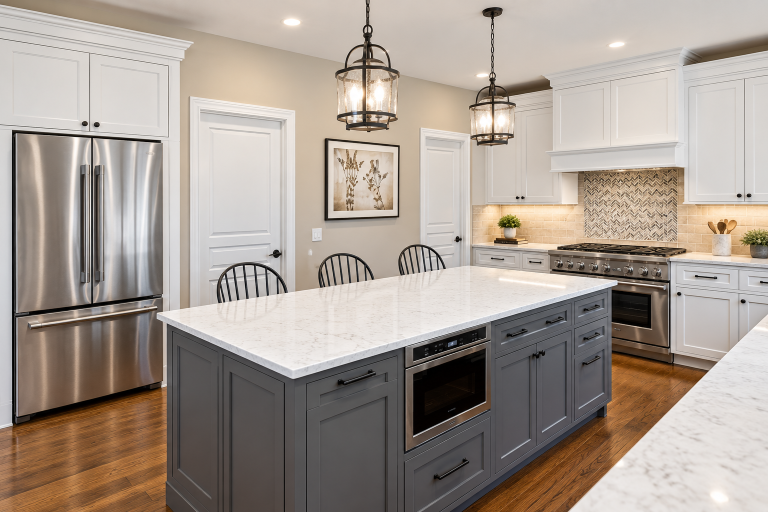
Overhead light can leave counters in shadow when you stand between the fixture and your work. Plan undercabinet lighting for even coverage, including corners. Coordinate lighting over the sink, range, and island with the final layout. Pendants should support island activities while preserving comfortable sightlines.
Consider Light Color and Color Quality
Color temperature affects whether light feels warm or cool. Color rendering affects how naturally food and finishes appear. View lighting samples with your cabinet, countertop, and flooring selections. Coordinate fixtures so the room feels cohesive. These qualities depend on the selected lamp or fixture and are included in its investment rather than a separate lighting category.
Give Yourself Control
Bright light helps with preparation and cleanup; softer light creates a comfortable setting for conversation. Separate controls for ceiling, pendant, and undercabinet lighting make that transition easier. Confirm that LED lamps, fixtures, drivers, and dimmers are compatible. Smart controls can add convenience, but consider whether their features fit your routine.
Watch for Glare
Exposed bulbs and reflections on glossy surfaces can feel uncomfortable. Diffusers, shielded light sources, and thoughtful fixture positioning help. Check pendant size and hanging height from both standing and seated positions. As eyes age, better illumination and careful glare control can make everyday tasks more comfortable.
Plan the Investment Before Construction
Settle fixture locations, switch placement, cabinetry details, and accessible power supplies before walls close. Existing wiring, ceiling access, and decorative selections influence the investment. A qualified electrician should confirm applicable installation requirements. Review the overall lighting plan and the total fixed investment for the agreed remodeling scope.
The best kitchen lighting earns its place every day: helping you cook comfortably, welcome guests, and enjoy time together. Investing in a coordinated plan makes those ordinary moments more enjoyable.
Approximate Lighting Investment Ranges
These broad U.S. planning estimates were checked against published market guides in October 2026. Each range includes typical equipment and routine professional installation for the stated scope. Local conditions and premium selections can increase the investment.
| Component or approach | Approximate investment | Included scope and limits |
| Recessed LED downlight | $135–$310 each | Typical new LED downlight and accessible installation; dimmer and ceiling repairs are additional. |
| Basic ceiling fixture | $70–$250 each | Standard flush or semi-flush fixture at a suitable electrical location; premium fixtures are additional. |
| Standard pendant | $100–$300 each | Mainstream pendant with routine mounting and connection; luxury fixtures alone may exceed $1,000. |
| Decorative chandelier | $220–$3,400 each | Fixture and installation vary widely by size and finish; unusual support or ceiling access can add investment. |
| Undercabinet LED lighting | $20–$100 per linear foot | Typical lighting and installation; custom hardwired systems may exceed this range. Confirm whether drivers and dimming are included. |
| Simple LED strip accent lighting | $70–$400 per run | A basic strip installation for a shelf or cabinet feature; custom channels, extensive wiring, and multiple runs add investment. |
| LED-compatible dimmer | $80–$200 each | Typical dimmer installation at a suitable existing switch location; additional wiring or controls are separate. |
| Smart lighting switch | $80–$250+ each | Typical switch and installation with suitable wiring; hubs, companion controls, and setup may be additional. |
| New or relocated switch | $100–$300 per location | Typical switch location work with accessible wiring; wall repairs and specialized controls may be additional. |
These are planning comparisons, not amounts to add automatically. Ceiling fixtures and pendants may serve alternative layouts; choose a standard or smart control where appropriate. Confirm the scope so switches, drivers, and wiring already included in an installation are not counted again.
For illustration, six recessed lights at $225 each, two pendants at $250 each, 12 linear feet of undercabinet lighting at $60 per foot, and three dimmers at $150 each represent an approximate $3,020 investment. This example assumes the lighting allowances exclude dimmers and suitable switch locations are already available.
Permits, taxes, major rewiring or panel work, ceiling or wall repairs, painting, and design or project management are outside this example. A fixed lump-sum proposal establishes the total investment for the agreed project, including the selected scope and exclusions.
Educational references: DOE light color • Lutron LED compatibility • HomeGuide fixtures • HomeGuide recessed lighting • HomeGuide controls • Angi undercabinet lighting