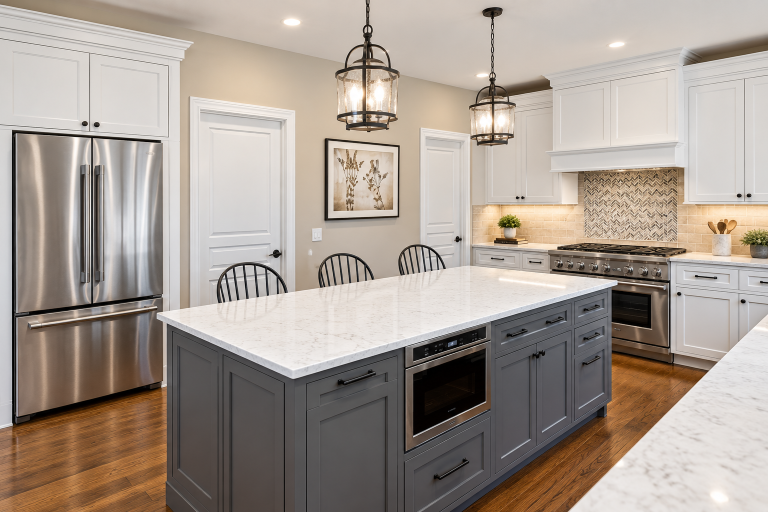
A kitchen that supports everyday meals and gatherings with family and friends needs more than an attractive range and hood. Gas supply, exhaust ductwork, and replacement air work together to support safe operation and comfortable cooking. Understanding these details helps you plan the investment before construction begins.
Match the Gas Supply to the Range
A larger gas range may require more fuel than the existing piping can deliver. Proper sizing considers appliance demand, pipe length, and other equipment sharing the supply. Approved connections, an accessible shutoff valve, required testing, and manufacturer-specified clearances also matter. Selecting the appliance early helps establish the scope.
Give Cooking Exhaust a Route Outdoors
A ducted hood must discharge outdoors through a smooth, airtight duct, independent of other exhaust systems and equipped with a backdraft damper. It cannot discharge into an attic, crawl space, or wall cavity. Duct size and routing must follow the equipment’s instructions.
A listed recirculating hood may be permitted under specific conditions, but it does not remove cooking exhaust outdoors. Hood selection should consider cooking habits, capture area, airflow, and noise—not appearance alone.
Understand When Makeup Air Is Required
A powerful hood removes air from the home. Makeup air intentionally replaces that air from outside. Without enough replacement air, the hood can lower indoor pressure and potentially draw combustion gases backward from certain fuel-burning equipment.
Under the 2021 residential code, makeup air is required for an exhaust system capable of more than 400 cubic feet per minute (CFM) when a fuel-burning appliance inside the home’s air barrier is neither direct-vented nor mechanically draft-vented. A gas cooking appliance can qualify; an electric range does not eliminate the requirement if another qualifying appliance is present.
Plan for Airflow and Comfort
Required makeup airflow must approximately match exhaust airflow and use an approved damper arrangement. Opening a window is not a substitute for the required system. Some installations use a damper and duct; others need a supply fan and coordinated controls.
In colder climates, heating incoming air can improve comfort and may increase electrical requirements. Heating is not automatically required by the makeup-air provision alone. Makeup air replaces exhausted air; combustion air supplies oxygen for fuel-burning equipment. Both deserve consideration.
Invest in a Coordinated Plan
Confirm the applicable code, existing conditions, and manufacturer instructions during design. Then review the total fixed investment and the agreed scope, including the selected appliances and ventilation approach. Thoughtful planning supports a kitchen where cooking and sharing meals feel comfortable for years to come.
Approximate Investment Ranges
The following are broad U.S. planning estimates checked against market guides and equipment examples in October 2026. They are not local quotations. Access, equipment selection, airflow, duct length, and existing systems determine the final investment; complex installations may exceed these ranges.
| Component or approach | Approximate investment | Included scope and limits |
| Gas range or cooktop equipment | $800–$3,000 | Typical mainstream appliance only; premium cooking equipment may be $3,000–$10,000 or more. |
| Gas connection at a suitable existing location | $200–$600 | Approved connector, accessible valve as needed, and connection/leak checks; no new piping route. |
| Short gas-line extension or relocation | $500–$1,500 | Typical accessible kitchen piping work, valve, and required testing; excludes utility service upgrades. |
| Longer or larger gas-piping run | $1,000–$3,000+ | A longer run or replacement of undersized piping; scope depends on the entire gas system. |
| Standard ducted hood with straightforward installation | $700–$2,000 | Typical hood, mounting, and connection to suitable existing ductwork and electrical supply. |
| New exterior exhaust duct route | $500–$2,000+ | Accessible duct run, fittings, exterior termination, and installation; separate from the hood allowance. |
| Basic unheated makeup-air system | $1,500–$3,500 | Sized intake, duct, damper, controls as needed, and straightforward installation; no supply fan or heater. |
| Powered unheated makeup-air system | $3,000–$6,000 | Supply fan, intake/filter, ductwork, damper, coordinated controls, and routine electrical connections. |
| Powered makeup air with heating | $5,000–$10,000+ | Powered system plus heater and associated controls/electrical work; major panel upgrades are additional. |
These are alternative scopes, not a checklist to add together. Choose one applicable gas approach and one makeup-air approach. Premium hoods, remote blowers, and decorative enclosures require separate planning. Permits, taxes, wall or roof repairs, cabinetry changes, and design or project management may be additional.
For example, a $900 gas extension, a $1,200 hood installation, $1,000 of new exhaust ductwork, and a $2,500 basic makeup-air system represent an approximate $5,600 investment, excluding the cooking appliance and other additional work. The contractor’s fixed lump-sum proposal establishes the total investment for the agreed project.
References: 2021 IRC M1503 • IRC fuel gas • HomeGuide gas piping • HomeGuide hood installation • Broan makeup air • Fantech systems