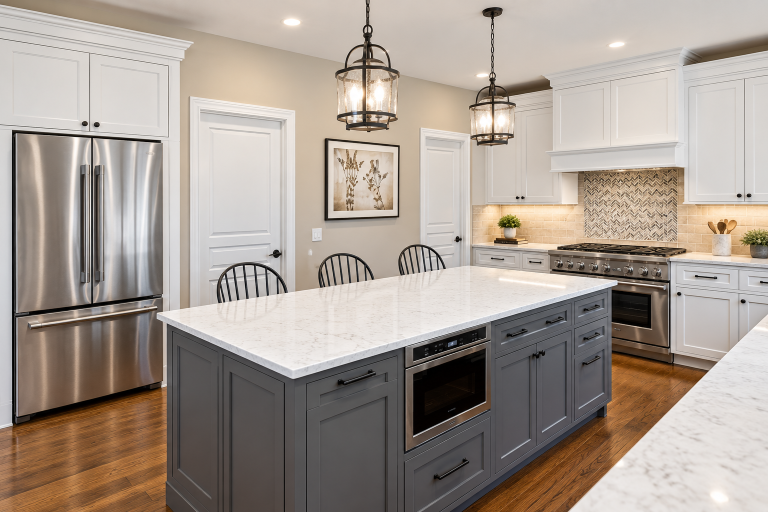
A kitchen remodel often involves more electrical work than moving a few outlets. New appliance selections, a different layout, and applicable safety requirements can change what the electrical system must provide. Planning this investment early helps create a kitchen that supports everyday cooking and gatherings with family and friends.
Match Circuits to the Way You Cook
Coffee makers, toasters, and air fryers can place substantial demands on countertop circuits. Kitchen small-appliance circuits distribute that demand. Dishwashers, microwaves, and other equipment may need individual circuits, depending on their ratings, manufacturer instructions, and applicable code. An electric or induction range usually needs a dedicated 240-volt supply sized for the selected appliance.
Keeping existing appliances does not automatically eliminate electrical upgrades. Moving an appliance, extending wiring, or changing the surrounding layout can affect the work required. Select equipment early so its electrical needs can be incorporated into the plan.
Locate Outlets for Everyday Use
Countertop outlet placement helps you use appliances without stretching cords across work areas, sinks, or cooktops. Islands and peninsulas deserve particular attention because hanging cords can be pulled or snagged. Their outlet requirements have changed between code editions; confirm the locally adopted rules before choosing an outlet arrangement or cutting into a countertop.
Understand GFCI and AFCI Protection
A ground-fault circuit interrupter, or GFCI, reduces shock risk by disconnecting power when it detects an imbalance in current. An arc-fault circuit interrupter, or AFCI, detects certain dangerous arcing conditions and helps reduce electrical fire risk. These devices address different hazards, and some kitchen circuits need both types of protection.
Protection may be provided through an approved receptacle arrangement, a compatible circuit breaker, or a dual-function breaker. Every protected outlet does not necessarily need its own GFCI device. The electrician should determine the appropriate method and required coverage for the adopted code and existing wiring.
Evaluate Existing Wiring and Panel Capacity
Some existing wiring can remain when its condition and the remodel scope allow. Damaged wiring, missing grounding, or inadequate circuits may need correction. The electrician should evaluate electrical demand and available panel capacity before adding equipment. A subpanel adds circuit space but does not increase the capacity of the home’s electrical service.
Plan the Total Fixed Investment
Electrical requirements depend on the locally adopted code, manufacturer instructions, and the work being performed. Remodeling one kitchen does not automatically require rewiring the entire house. Confirm the agreed scope, necessary permits and inspections, and the total fixed investment before construction.
Well-planned electrical work supports the kitchen you use every day. It is an investment in dependable appliance operation and a comfortable place to prepare meals and make memories together.
Approximate Electrical Investment Ranges
These broad U.S. planning estimates were checked against published market guides in October 2026. They include typical materials and professional installation for the stated scope. Local labor, wiring access, circuit length, and existing conditions can increase the investment.
| Component or approach | Approximate investment | Included scope and limits |
| New small-appliance or individual appliance circuit | $250–$900 per circuit | Typical accessible branch circuit with breaker and wiring; confirm whether its outlet and required protection are included. |
| Dedicated electric or induction range circuit | $250–$900+ per circuit | Straightforward 240-volt circuit and outlet or hardwired connection; long runs, heavier wiring, and added protection can exceed this range. |
| New countertop or appliance outlet | $150–$350 each | Typical new 120-volt outlet, including a basic GFCI option, on a suitable circuit; a new circuit is separate. |
| Replace an outlet with a GFCI receptacle | $90–$200 each | Suitable existing box and wiring; repairs or rewiring are additional. This is an alternative to some breaker-based protection. |
| Replace a breaker with required protective equipment | $100–$600 each | Broad breaker-replacement allowance; AFCI, GFCI, or dual-function selection depends on the circuit and panel. Excludes a new wiring run. |
| Accessible wiring run or replacement | $7–$10 per linear foot | Typical accessible wire installation; this is a planning comparison, not a substitute for a complete circuit allowance. |
| Typical new 200-amp main panel | $1,800–$2,500 | Panel and routine installation; utility service changes, meter work, relocation, and extensive corrections may add substantial investment. |
| Typical 100-amp subpanel | $500–$1,500 | Subpanel and straightforward installation; confirm feeder scope. New kitchen branch circuits are separate. |
These are comparisons, not a checklist to total. A circuit allowance may already include wiring, a breaker, and an outlet. GFCI receptacles and protective breakers may provide overlapping protection. Panel replacement and a subpanel are alternatives in some projects; neither is automatically required.
For illustration, three new circuits at $650 each and four additional outlet locations at $250 each represent an approximate $2,950 investment. This assumes the circuit allowances include their required breakers, wiring, connections, and protection, and the four outlet locations are separate from those circuits’ included connections.
Electrical permits commonly represent an additional $50–$350 investment; inspection may be included or separate. Appliances, decorative lighting, wall repairs, painting, extensive wiring corrections, and design or project management are outside this example. The fixed lump-sum proposal establishes the total investment for the agreed remodeling scope.
Educational references: NFPA kitchen safety • NEMA AFCI guidance • HomeGuide circuits • HomeGuide GFCI outlets • HomeGuide breakers • HomeGuide panels • HomeGuide subpanels • HomeGuide wiring